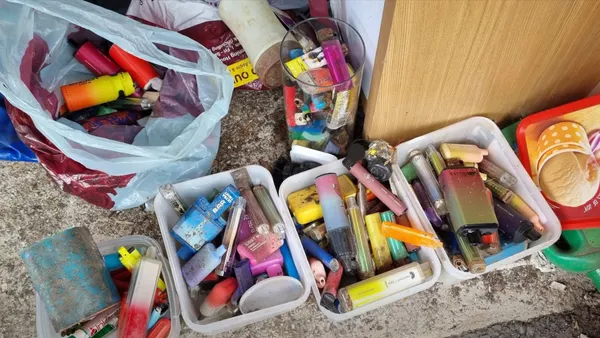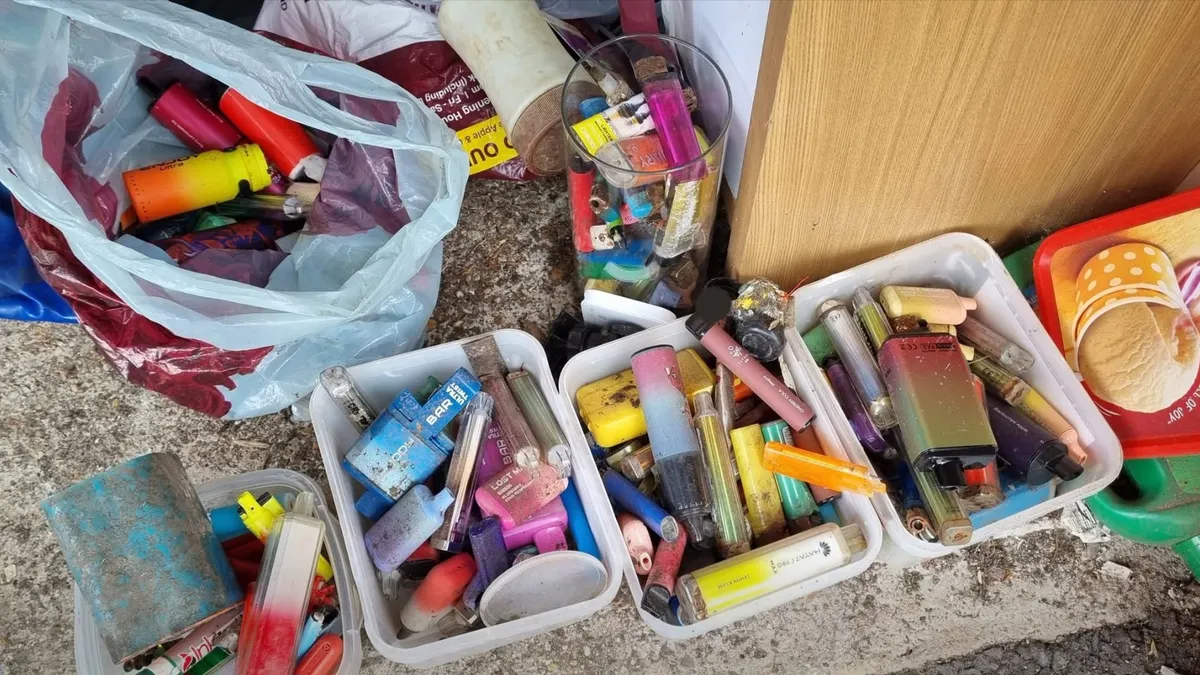
A Wisconsin firefighter has started a one-man vape collection service in an effort to prevent fires and littering, particularly in rural parts of the state where such services are limited or nonexistent.
Raymond Tucker launched EcoVape Recovery earlier this year and is focusing on small-scale collection services for vape shops, schools and other community groups.
Recycling isn’t Tucker’s day job. He repeatedly encounters littered vapes during his work for the Wisconsin Department of Natural Resources, where he does forestry work, trail maintenance and monitors for wildfire incidents.
“Our state forest area is pretty remote, and I still find them in the furthest part of the horse trail just laying in the woods when I'm out there mowing or something. I was wondering, shouldn’t we be recycling these?” he said.
Vapes are a leading cause of waste and recycling facility fires due to the lithium-ion batteries inside, but there are few outlets for users to safely dispose of the devices even as the popularity of these products rises.
Tucker also sees his business as a way to align with initiatives already taking place in the state. Wisconsin restricted sales of certain types of e-cigarettes in 2025, and future restrictions related to hemp-related vapes are set to go into effect in July. Some vape shops may consider disposing of vapes that are no longer fit for sale.
The state also has an ongoing plan to prevent youth vaping, funding youth prevention and education initiatives as part of a $14.7 million settlement with vape maker Juul Labs over targeted e-cigarette marketing to underage consumers. Tucker hopes safe vape collection initiatives can be a key part of the process.
Tucker’s business is a self-funded operation that charges for collection services. He hopes to partner with more businesses and entities to increase collection over time. He has also started reaching out to local recycling organizations and lawmakers to move forward with larger-scale recycling initiatives he hopes could target vape waste on a more formal scale. He currently sends the vapes to the local recyclers that can accept these products for further processing, but he’s looking for more outlets. “There are already so few out there,” he said.
Waste Dive spoke with Tucker about his business model and his goals for safer vape collection in his neighborhood and across the country.
This conversation has been edited for length and clarity.
WASTE DIVE: How did you get started?
RAYMOND TUCKER: I went to my local tobacco shop to buy cigarettes and asked them what they do with their used vapes, and some just toss them. I started looking up what the rules are and saw there's some state guidance out there, but no [direct laws banning vape disposal] in Wisconsin right now.
Where I live is not a big town, so not a lot of places will accept them for recycling. I thought that there needs to be somebody to go out and do something about it. So I offer safe collection bins for them. What I didn’t want to do is become like those cigarette butt cans at gas stations, where people just keep putting their butts in there until it’s overflowing.
Right now I work with a local smoke shop, and I’m talking with schools, a youth prevention program, and some other places to see how we can partner on other ways to collect them.
At some schools, when a kid gets caught with a vape, they just give it back to the parents because they can’t have these piling up in a counselor’s drawer. It makes it easier for kids to get the vapes back in the end, and we don’t want that.
Or, if people just discard it at home, it’s going into the regular household trash and is not getting recycled. Those things have a lithium battery, which can cause fires. There's a lot of plastic components, and some of them even have microchips in them because the new ones that they're putting out have video games on them, which I couldn’t believe. There’s so many ways these are marketed to kids, like making them look like highlighters so they’re easier to hide.
How are you collecting and storing the vapes after you collect them, and where do they go next?
I’m starting small. I have a locking-lid, 25-gallon steel drum with vermiculite in the bottom, and I only store them for about three days or less. I don't think anybody should be holding onto them for very long. I’ve also been talking with the EPA and with DNR to make sure everything is according to the rules, and the way I operate now, the vapes are considered household waste. If I expand, we will look at what licenses or permits might be needed.
Right now I take them to a [processor] near Pine City, Minnesota, or another recycler near Somerset in Wisconsin. I’ve also had other recyclers in the state reach out to me to ask what I do with the vapes, because I’m the only person they could find nearby who was doing this. I know there's some other companies out there around the country trying to do something about it, because it is an issue, but it is rare.
Being self-funded, I focus locally because I wanted it to be a community thing. The first week, I collected six pounds. I dropped the vape bin off at the smoke shop on February 24. On March 8, they were calling me to come pick it up because it was so full they couldn't put the lid back on it.
From what I'm told, the initial influx is likely because people have been just storing them at home with nowhere to put them. So far, I've been offering free pickups for the first 90 days because I feel like some smoke shops might want to avoid billing by just throwing them away. But we see that there’s a demand. People send me pictures of their piles of vapes, sometimes at their homes, and ask me if I can come pick them up.
Now that you’re in the business yourself, what do you see as being the best course of action, either from a policy level or a business level, to better manage these vapes at the end of life?
Hindsight is 20-20, but I don't think [vape companies] really thought about how they were going to deal with the back-end issue. It's not designed to be recycled, or they’re marketed as “rechargeable disposals,” which makes no sense.
I'm Joe Schmo and I have figured out a way to at least collect them, so why haven’t we been able to figure out a bigger solution?
What we need is a more mainstream solution, or maybe a wider state or federal process or entity that can figure out a larger-scale way to handle these. What if your regular household garbage man could come pick them up? What if there was a convenient place to take them? It really should have been in the business plan when [vape manufacturers] decided to make these.