Dive Brief:
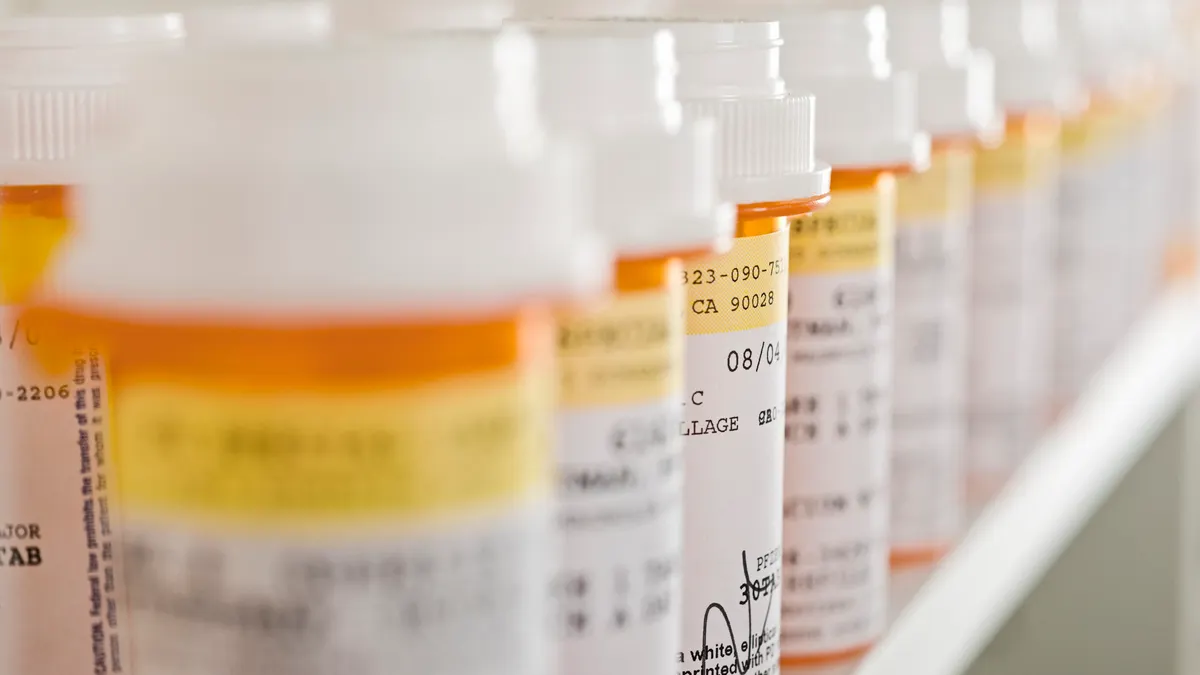
- Prescription pill bottles are rarely recycled due to a mix of regulatory considerations and complex healthcare management hurdles, despite being made from plastics that are widely recycled in the United States, according to a new report from the Closed Loop Center for the Circular Economy.
- The report delves into options for improving pill bottle recovery and recycling. It also acknowledges hurdles such as the bottles’ small size, lack of acceptance in most curbside programs and healthcare industry concerns over patient privacy and medication management.
- The report calls for closer collaboration between pharmacies, manufacturers, recyclers and stewardship organizations to “navigate structural, regulatory, and liability concerns” to divert more of these materials from disposal.
Dive Insight:
More prescriptions are being filled in the United States than ever before, and that means more prescription pill bottles are being disposed, according to the report. Today, the amount of prescription pill bottles recycled in a year across the U.S. “appears to be small” compared to the amount likely landfilled or combusted, the report says.
The new report notes that these materials are flowing through highly complex medical environments, where patient safety and healthcare compliance take priority over recycling streams.
Regulatory hurdles also affect recovery and recycling. Federal guidance “limits the use of post-consumer recycled plastic in primary pharmaceutical packaging, constraining certain closed-loop applications,” the report says. Meanwhile, policies like extended producer responsibility for packaging typically exclude health and medication-related packaging.
Collecting these materials is a far bigger challenge than finding end markets, according to the report. The pill bottles are typically made of HDPE or PE rigid plastic, which have established end markets with demand “that far outstrips the amount of prescription pill bottles used annually in the United States,” the report says.
Despite the hurdles, there are opportunities to boost recycling for these materials while also taking compliance into consideration, said senior project director Matt Pundmann in an email to Waste Dive.
One key is recognizing what he calls the “dual nature” of pill bottles: both a vessel created for security and compliance and also a small-format consumer package. The Closed Loop Center for the Circular Economy is working long-term on research and advocacy around improving recycling systems for small-format consumer packaging, he said.
Pill bottle recovery “represents a significant opportunity for circularity within a much larger plastic waste challenge, if we take into account the nuances of this packaging type and its real-world constraints,” added Kate Daly, CEO of the Closed Loop Center for the Circular Economy, in a statement. “Recovering more of these valuable materials will require alignment across collection systems, regulatory safeguards and end market demand, and coordinated action by retail pharmacies, manufacturers and recyclers.”
The report explores recycling options for two main types of prescription pill bottles. Packer bottles, also called stock bottles, are larger containers that hold bulk amounts of medications before they’re dispensed into the smaller pill bottles patients take home.
Then there are “unit-of-use” bottles, which are the smaller bottles given directly to patients with their specific prescription. These bottles often have labels with patient information and can sometimes have tamper-proof seals made of non-plastic materials like aluminum.
Between 8,000 and 17,000 tons of packer bottles and caps are discarded each year, while between 16,000 and 43,000 tons of unit-of-use bottles are discarded a year, according to the report.
Packer bottles may have a more straightforward path toward improved recycling collection compared to unit-of-use bottles. That’s because they’re a larger format that aren’t as likely to fall through the cracks at MRFs compared to the unit-of-use types.
Packer bottles stay inside controlled pharmacy or healthcare settings, meaning pharmacists can put them directly into recycling bins when they’re empty “as part of their normal workflow” instead of needing to track them down in other parts of a healthcare center. These bottles also don’t have labels with patient information, cutting down on privacy concerns, according to the report.
Training employees on collection strategies and lining up reliable pathways to collect the material for further recycling will make packer bottle recovery a more successful process, the report said. But commercial waste contractors may also need the right volume to make the collection process financially viable.
Unit-of-use bottles have more challenges stacked against them, the report says, with size being one. Most of these bottles fall below the two-inch “small format” threshold, making them prone to falling through equipment at MRFs or not being sorted properly compared to larger format containers.
These small containers are also meant to go home with patients, meaning they don’t have a straightforward path back to recycling facilities because they rely on consumers to find a specific take-back program. And state or municipal take-back programs are designed to help people safely drop off pills but don’t typically but don’t typically focus on recycling of the bottle itself.
Many MRFs don’t accept the smaller unit-of-use bottles in curbside collection programs. Yet some pill bottles still get collected through this pathway and may end up being sorted and baled through ”incidental capture,” the report says.
Unit-of-use bottles may also be collected and recycled through what the report describes as “niche programs” that advertise pill bottle collection and recycling services. For instance, CLP highlighted a pilot program from data destruction and shredding company Iron Mountain, which collected empty unit-of-use bottles from 3,000 pharmacy locations. That program resulted in the collection and shredding of 3,500 tons of containers. That material was taken to a chemical recycling facility to be processed using pyrolysis.
Iron Mountain found that shredding helped destroy patient health information on the bottles, a key consideration in scaling this kind of program long term, according to the report. Operators would need to consider how to streamline the chain of custody for these materials, the report said.
Looking to the future, CLP’s report recommends more research into how existing product stewardship systems and specialty at-home collection programs can play a bigger role in collecting these unit-of-use containers.
It also recommends recyclers consider improving sortation technology for smaller format containers while also discussing ways to better aggregate the material for further recycling.
“Regardless of how a prescription pill bottle is collected, recycling depends on whether the material successfully moves through each stage of the recycling value chain,” the report says, noting that “collection alone does not guarantee recovery.”
This story first appeared in the Waste Dive: Recycling newsletter. Sign up for the weekly emails here.